
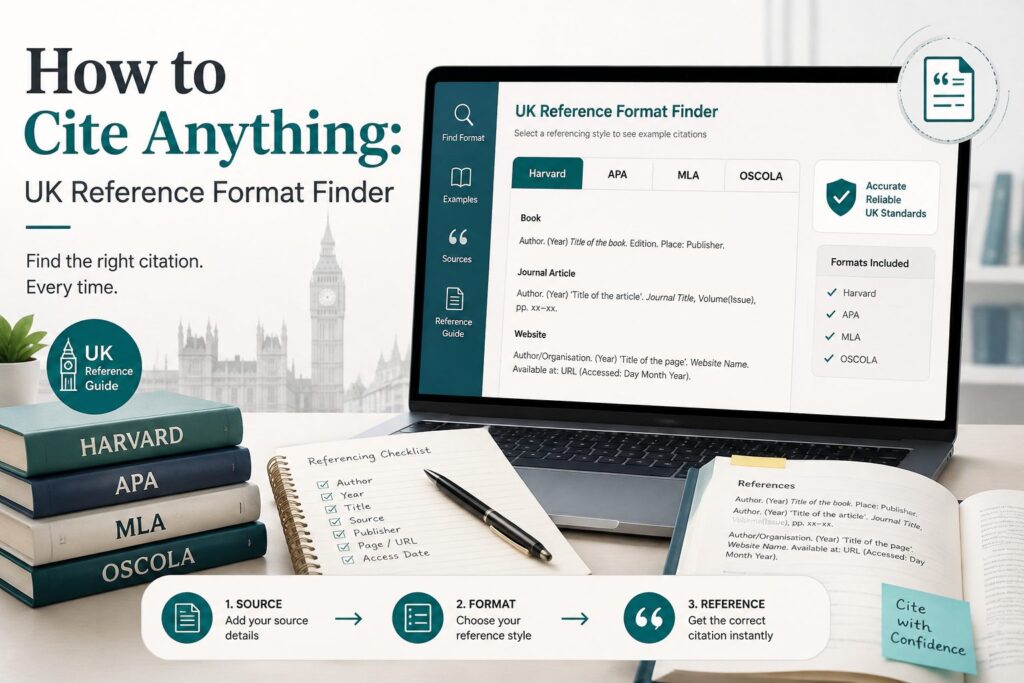






You have one source in front of you, a report, a law, a podcast episode, an AI tool’s answer, and you need to know how to cite it correctly before your deadline. Not a lecture on why referencing matters. Not a history of citation styles. Just the exact format, in the style your university actually uses.
This page is built as a lookup tool rather than an article to read start to finish. Find your source type below, find your style (Harvard, APA 7th, OSCOLA, Vancouver or MHRA), and copy the pattern. Every entry shows the in-text citation and the full reference-list version side by side, so you can see exactly where each piece of information goes.
A quick word of warning first. Markers notice inconsistent referencing even when the research behind it is excellent, and a citation in the wrong style can cost marks in its own right. If in doubt, your module handbook or supervisor has the final say over anything on this page.
One Source, Five Styles at a Glance
Before the full breakdown below, here is the same source cited correctly in all five styles, so you can see at a glance how differently each one treats identical information.
Source: a book by Jane Smith, published in 2023, titled ‘Understanding Academic Writing’, second edition, published in London by Sage.
Harvard: (Smith, 2023) in the text. Smith, J. (2023) Understanding academic writing. 2nd edn. London: Sage. in the reference list.
APA (7th edition): (Smith, 2023) in the text. Smith, J. (2023). Understanding academic writing (2nd ed.). Sage. in the reference list.
OSCOLA: No in-text citation at all, a footnote instead: Jane Smith, Understanding Academic Writing (2nd edn, Sage 2023) 45.
Vancouver: A number in the text, such as (1). 1. Smith J. Understanding academic writing. 2nd ed. London: Sage; 2023. in the numbered reference list.
MHRA: A footnote too, but formatted differently from OSCOLA: Jane Smith, Understanding Academic Writing, 2nd edn (London: Sage, 2023), p. 45.
Look closely at what actually changes: whether the author’s name is surname-first or forename-first, the punctuation between elements, whether the citation lives in the body text or in a footnote, and whether a page number appears by default. Get one of these details wrong and the citation reads as a different style entirely, which is precisely what markers are trained to spot.
Which Referencing Style Should You Use?
Before anything else: check your module handbook or ask your supervisor. This section only helps when your university genuinely hasn’t told you, which is rarer than students think.
Harvard
Harvard is the most widely used referencing style in UK higher education. You will meet it across business, the social sciences, education and a good share of the humanities. It uses author-date citations in the text, such as (Smith, 2023), and a single alphabetical reference list at the end.
APA (7th edition)
APA is common in psychology, education and parts of the social sciences. Always check the edition your department expects, since the move from 6th to 7th edition changed several rules, including how many authors you list before switching to ‘et al.’ Like Harvard, APA uses author-date citations, but the punctuation and formatting details differ in ways that markers do notice.
OSCOLA
OSCOLA is the referencing style used at every UK law school, without real exception. It works entirely differently from Harvard and APA: citations appear as footnotes rather than in the body of your text, and the footnote number sits after the punctuation it relates to. If you study law, learn this style properly rather than trying to adapt Harvard habits to it.
Vancouver
Vancouver is the standard in medicine, nursing, pharmacy and most health sciences courses. It uses a numbered citation system: each source gets a number the first time you cite it, and that same number is reused every time you cite it again, in whatever order the sources first appear in your text.
MHRA
MHRA appears mainly in English literature, history and some other humanities subjects. Like OSCOLA, it uses footnotes rather than author-date citations in the text, but its formatting conventions, especially punctuation and the order of information, are different from OSCOLA’s. Do not assume the two are interchangeable.
Some UK universities also run their own house variant of Harvard, with small local differences from the standard version. Our Harvard referencing guide covers this in detail if Harvard is your style.
None of these five styles is objectively ‘better’ than another. They exist to serve different disciplines’ conventions around evidence, and a marker in one field will expect the citation habits of that field regardless of how comfortable you are with a different one from a previous module. If you’re studying a joint degree and switching styles between modules, treat each assignment as a clean slate rather than carrying habits across.
| Discipline | Typical style |
|---|---|
| Business, social sciences, education | Harvard |
| Psychology, some social sciences | APA (7th edition) |
| Law | OSCOLA |
| Medicine, nursing, health sciences | Vancouver |
| English, history, humanities | MHRA |
How to Cite Every Source Type: Worked Examples in Five UK Styles
Every entry below follows the same pattern: the in-text citation first, then the full reference-list or bibliography version. Where OSCOLA, Vancouver or MHRA would produce an identical-looking format to Harvard or APA for that particular source type, we’ve left them out rather than pad the page with repeats. Swap in your own author, date and title, and the structure stays the same.
Book
Harvard In-text: (Smith, 2023) or Smith (2023) argues that… Reference list: Smith, J. (2023) Understanding academic writing. 2nd edn. London: Sage.
Two authors become (Smith and Jones, 2023) in the text, with both names in the reference list. Three or more authors are shortened to (Smith et al., 2023) in the text, though UK Harvard variants differ on how many authors to list in full in the reference list itself, so check your handbook.
For a book with three or more authors, the reference list entry usually still names every author rather than shortening to ‘et al.’, even though the in-text citation is shortened. For example: Smith, J., Jones, K. and Patel, R. (2023) Understanding academic writing. 2nd edn. London: Sage. Some institutions cap this at the first three names followed by ‘and others’, so check your own handbook if your source has a long author list.
Book referencing is where most Harvard mistakes actually happen, from missing editions to wrong punctuation between elements. Our Harvard referencing guide breaks down the eight most common errors markers see, if you want to check your own reference list against them.
APA (7th edition) In-text: (Smith, 2023) Reference list: Smith, J. (2023). Understanding academic writing (2nd ed.). Sage.
MHRA Footnote: 1 Jane Smith, Understanding Academic Writing, 2nd edn (London: Sage, 2023), p. 45. Bibliography: Smith, Jane, Understanding Academic Writing, 2nd edn (London: Sage, 2023)
Edited Book Chapter
Cite the chapter author and title, not the book editor, as the primary reference, then credit the editor and book title separately.
Harvard In-text: (Brown, 2022) Reference list: Brown, K. (2022) ‘Referencing in the digital age’, in Patel, R. (ed.) Academic skills for the twenty-first century. Oxford: Oxford University Press, pp. 112-130.
APA (7th edition) In-text: (Brown, 2022) Reference list: Brown, K. (2022). Referencing in the digital age. In R. Patel (Ed.), Academic skills for the twenty-first century (pp. 112-130). Oxford University Press.
Journal Article
Harvard In-text: (Ahmed, 2024) Reference list, print or online with a DOI: Ahmed, S. (2024) ‘Digital literacy and undergraduate performance’, Journal of Higher Education Studies, 18(3), pp. 55-72. doi:10.1080/xxxx.
APA (7th edition) In-text: (Ahmed, 2024) Reference list: Ahmed, S. (2024). Digital literacy and undergraduate performance. Journal of Higher Education Studies, 18(3), 55-72. https://doi.org/10.1080/xxxx
Vancouver In-text: Digital literacy has been linked to academic performance (1). Reference list, numbered in order of first citation: 1. Ahmed S. Digital literacy and undergraduate performance. J High Educ Stud. 2024;18(3):55-72.
Use the DOI whenever the article has one. If it doesn’t, use the URL of the page where you accessed it, and add an access date only if your style guide asks for one, since most current UK styles no longer require it for stable sources.
OSCOLA, for a law journal article: Footnote: 1 Sara Ahmed, ‘Digital Literacy and Undergraduate Performance’ (2024) 18 J High Educ Stud 55, 60. The volume number comes before the journal abbreviation, with no comma between them, which trips up students moving across from Harvard or APA.
MHRA, for a humanities journal article: Footnote: 1 Sara Ahmed, ‘Digital Literacy and Undergraduate Performance’, Journal of Higher Education Studies, 18 (2024), 55-72 (p. 60).
Website
Harvard In-text: (British Council, 2025) Reference list: British Council (2025) Studying in the UK: a guide for international students. Available at: https://www.britishcouncil.org/study-uk (Accessed: 12 August 2026).
APA (7th edition) In-text: (British Council, 2025) Reference list: British Council. (2025). Studying in the UK: a guide for international students. https://www.britishcouncil.org/study-uk
When a webpage has no named author, use the organisation that published it, as in the example above. When a page has no visible date, use ‘n.d.’ in place of the year, both in-text and in the reference list.
Websites rarely appear in OSCOLA or Vancouver in their own right, since law and health sciences generally expect published, peer-reviewed or officially issued sources. Where a website genuinely is the only available evidence in one of those disciplines, follow the closest equivalent pattern above and flag it to your supervisor rather than guessing.
Newspaper and Magazine Article
Harvard In-text, with a named journalist: (Hughes, 2026) Reference list: Hughes, T. (2026) ‘Universities report record demand for referencing support’, The Guardian, 4 March, p. 12.
APA (7th edition) In-text: (Hughes, 2026) Reference list: Hughes, T. (2026, March 4). Universities report record demand for referencing support. The Guardian, 12.
Online versions follow the same core pattern but replace the page number with the URL. Articles with no named journalist are cited by publication name in place of an author, exactly as with an organisation-authored website.
Government Report
Harvard In-text: (Department for Education, 2025) Reference list: Department for Education (2025) Widening participation in higher education. London: DfE. Available at: https://www.gov.uk/government/statistics/widening-participation-in-higher-education (Accessed: 3 August 2026).
APA (7th edition) In-text: (Department for Education, 2025) Reference list: Department for Education. (2025). Widening participation in higher education. GOV.UK. https://www.gov.uk/government/statistics/widening-participation-in-higher-education
Treat the issuing department or agency as the author, since government reports rarely name an individual writer. This is the format to use for a statistical release, a white paper or a policy report published on GOV.UK.
UK Legislation
Law students cite legislation in OSCOLA. Some non-law modules ask for APA instead when legislation appears as supporting evidence in an essay, so both are shown here.
OSCOLA (the correct style for law) Footnote, first citation: 1 Data Protection Act 2018, s 3. Short form after that: 2 DPA 2018, s 5(2). No reference-list entry is needed separately; OSCOLA lists legislation in a dedicated table at the end of your bibliography, not mixed in with books and articles.
APA (7th edition), for non-law essays that reference an Act In-text: (Data Protection Act, 2018) Reference list: Data Protection Act 2018, c. 12. https://www.legislation.gov.uk/ukpga/2018/12/contents
Always cite the official text of the Act on legislation.gov.uk rather than a summary site, since only the official version is guaranteed accurate and current.
Secondary legislation, such as a Statutory Instrument, follows a similar OSCOLA pattern but with its own numbering: 3 Data Protection (Charges and Information) Regulations 2018, SI 2018/480, reg 4. Statutory Instruments are cited by year and number rather than by section alone, which is worth double-checking against the official text before you submit.
Case Law
OSCOLA uses the neutral citation where one exists, which is the standardised, court-assigned reference introduced for UK judgments since 2001.
OSCOLA Footnote, first citation: 1 R (Miller) v Secretary of State for Exiting the European Union [2017] UKSC 5 [25]. Short form after that: 2 Miller (n 1) [30].
The number in square brackets after the citation is the paragraph number you are referring to, not a page number, since UK judgments are paragraph-numbered rather than paginated. Older cases without a neutral citation use the relevant law report series instead, such as [1993] AC 789.
Scottish and Northern Irish cases follow the same broad OSCOLA principles but with their own court abbreviations, for example UKSC for the Supreme Court but CSIH for the Inner House of the Court of Session. If your module covers a UK jurisdiction beyond England and Wales, check the current OSCOLA guide for the exact abbreviation rather than assuming.
Thesis or Dissertation
Harvard In-text: (Basari, 2018) Reference list, unpublished: Basari, S.N.M. (2018) Academic writing in an EAP course: a pragmatic and critical approach to needs analysis. Unpublished PhD thesis. University of Sheffield. Reference list, in a repository: Basari, S.N.M. (2018) Academic writing in an EAP course: a pragmatic and critical approach to needs analysis. PhD thesis. University of Sheffield. Available at: White Rose eTheses Online (Accessed: 1 August 2026).
APA (7th edition) Reference list: Basari, S. N. M. (2018). Academic writing in an EAP course: A pragmatic and critical approach to needs analysis [Doctoral thesis, University of Sheffield]. White Rose eTheses Online. https://etheses.whiterose.ac.uk/id/eprint/23782/
Image, Figure or Table
When you reproduce someone else’s image, chart or table, credit it both under the image itself and in your reference list.
Harvard Under the image: Figure 3: UK higher education students by level of study, 2000/01 to present (Source: Higher Education Statistics Agency, no date). Reference list: Higher Education Statistics Agency (no date) Students by level of study [Chart]. Available at: hesa.ac.uk (Accessed: 2 September 2026).
If you created the figure yourself from data in another source, credit that underlying source instead, using the wording ‘Source: adapted from Higher Education Statistics Agency (no date)’.
APA (7th edition) Under the image: Figure 3. UK higher education students by level of study. Adapted from Students by level of study, by Higher Education Statistics Agency, n.d. Reference list: Higher Education Statistics Agency. (n.d.). Students by level of study [Chart]. https://www.hesa.ac.uk/data-and-analysis/students/chart-1
Podcast
Harvard In-text: (Mantel, 2017) Reference list: Mantel, H. (2017) ‘Adaptation’, The Reith Lectures. BBC Radio 4. Available at: bbc.co.uk (Accessed: 24 August 2017).
For a direct quote from a specific point in the episode, add a timestamp after the episode details, for example ‘at 14:32’.
APA (7th edition) In-text: (Mantel, 2017) Reference list: Mantel, H. (2017). Adaptation [Podcast episode]. In The Reith Lectures. BBC Radio 4. http://www.bbc.co.uk/programmes/b08x9947
Video or YouTube
Harvard In-text: (BBC My World, 2020) Reference list: BBC My World (2020) Fake news: how to spot it. YouTube video. Available at: youtube.com (Accessed: 9 August 2026).
Use the channel name as the author when the channel posts under an organisation name, and the presenter’s real name only when the channel is clearly an individual’s. If you are citing a specific claim rather than the whole video, add the timestamp in brackets after the year.
APA (7th edition) In-text: (BBC My World, 2020, 4:12) Reference list: BBC My World. (2020). Fake news: how to spot it [Video]. YouTube. https://www.youtube.com/watch?v=Pj4w0J6odJE
Social Media Post
Most UK marking criteria treat social media as a primary source you can analyse rather than academic evidence you cite as fact, so use it sparingly and check whether your module allows it at all.
Harvard In-text: (UK Parliament, 2026) Reference list: UK Parliament (2026) [replace with the post’s opening words or a short description]. X, [date of the post]. Available at: x.com/UKParliament (Accessed: 20 June 2026).
APA (7th edition) In-text: (UK Parliament [@UKParliament], 2026) Reference list: UK Parliament [@UKParliament]. (2026, [month day]). [replace with the post’s opening words or a short description] [Post]. X. https://x.com/UKParliament
Link to the specific post itself if your citation tool lets you copy its individual URL, since the profile link above only demonstrates the format. Most platforms show a permalink when you click the post’s timestamp.
AI Tool Output
Check your university’s policy before you cite an AI tool at all, since some UK institutions restrict or prohibit it outright, and using it without declaring it can be treated as an academic integrity issue rather than a referencing one.
Where your university does permit it, current UK guidance from Cite Them Right treats AI-generated text similarly to a personal communication: it isn’t a stable, retrievable source another reader could go and check, so it’s cited but not usually included in the reference list in the normal way.
Harvard, following Cite Them Right’s approach In-text: (OpenAI, 2026) No standard reference-list entry, since the output isn’t independently retrievable. Instead, describe what you asked and quote or summarise the response directly in your text, and check whether your university wants the full exchange included as an appendix.
Beyond the citation format itself, most UK universities now also expect a separate declaration of AI use somewhere in your submission, distinct from the reference list, stating which tool you used and roughly how. This isn’t optional decoration. Treat it the same way you’d treat declaring proofreading support: leaving it out when your institution requires it is what turns a legitimate research aid into an academic integrity problem.
Our full Harvard referencing guide covers this in more depth, including how the position has shifted since 2025.
Lecture Slides or Handout
Many UK universities actively discourage citing lecture slides, since they’re unpublished, unreviewed, and not something a marker or external examiner can verify. Where it’s permitted, here’s the format.
Harvard In-text: (Davies, 2026) Reference list: Davies, M. (2026) Week 4: Referencing and academic integrity [Lecture slides]. Module code 1234, University of Manchester. Available on the module’s virtual learning environment (VLE) (Accessed: 15 October 2026).
Lecture slides sit behind your institution’s login, so there is no public web address to give, unlike every other source type on this page. State where the material can be found (your module’s VLE, for instance) rather than inventing a URL that doesn’t exist.
The safer option, where possible, is to trace the claim back to the academic source your lecturer was drawing on, and cite that directly instead. If your university records lectures and posts a transcript or recording through its VLE, treat that the same way as slides: citable only where your module specifically allows it, and best avoided in favour of the underlying published reading wherever you can find one.
What to Do When Your Source Doesn’t Fit Any Template
Fifteen source types cover most of what you’ll cite, but not everything. Here’s how to handle what’s left.
No named author. Use the organisation, publisher or website name in the author position instead, exactly as shown in the Website and Government Report examples above.
No visible date. Use ‘n.d.’ (no date) in place of the year, both in the in-text citation and the reference list entry.
A source in another language. Give the title in the original language, followed by your own translation in square brackets, and note the language if it isn’t obvious from context.
A page that’s since been taken down. Cite an archived version through the Wayback Machine where one exists, and note the archive date alongside your original access date.
A personal communication, such as an email, a WhatsApp message or an in-person conversation. These are usually cited in the text only, with no reference-list entry, since a reader can’t retrieve them independently. Check whether your module allows this kind of source at all before relying on one.
Two or more sources by the same author in the same year. Add a lower-case letter after the year in both the in-text citation and the reference list, so the first becomes (Smith, 2023a) and the second (Smith, 2023b). Assign the letters in the order the sources appear in your reference list, which is usually alphabetical by title.
A source you found through a database rather than the publisher’s own site, such as a journal article accessed via your university library’s database. Cite the original publication details as normal, since the database itself is just where you happened to access it, not the source of the work.
When none of that fits, work through the underlying logic every style shares: identify the author, then the date, then the title, then the publisher or container, then how to find it again. Once you have those five pieces, slot them into the nearest template above in the right order for your style.
For anything genuinely unusual that these rules don’t resolve, ask your supervisor or your university’s academic skills team before you guess. A wrong assumption here is easy to make and just as easy to avoid by checking first.
Before You Submit
A reference list is one of the few parts of your assignment a marker can check in seconds, which is exactly why it’s worth getting right. Work through your draft against the templates above, confirm you’ve used one style consistently from first page to last, and double-check anything you weren’t sure about against your university’s own referencing guide rather than guessing.
Before you submit, run through a short check. Does every in-text citation have a matching entry in your reference list or bibliography, and vice versa? Is the style consistent across every single entry, not just the first few?
Have you used the current edition of your style, particularly if you’re using APA, since the 6th and 7th editions differ in ways markers are trained to notice? And for anything drawn from an AI tool, have you added the declaration your university requires, separately from the citation itself?
And if OSCOLA is giving you trouble specifically, work back through the case law and legislation examples above slowly rather than trying to memorise the whole style at once. Footnote referencing feels unfamiliar at first, but the pattern becomes automatic after a handful of citations.