
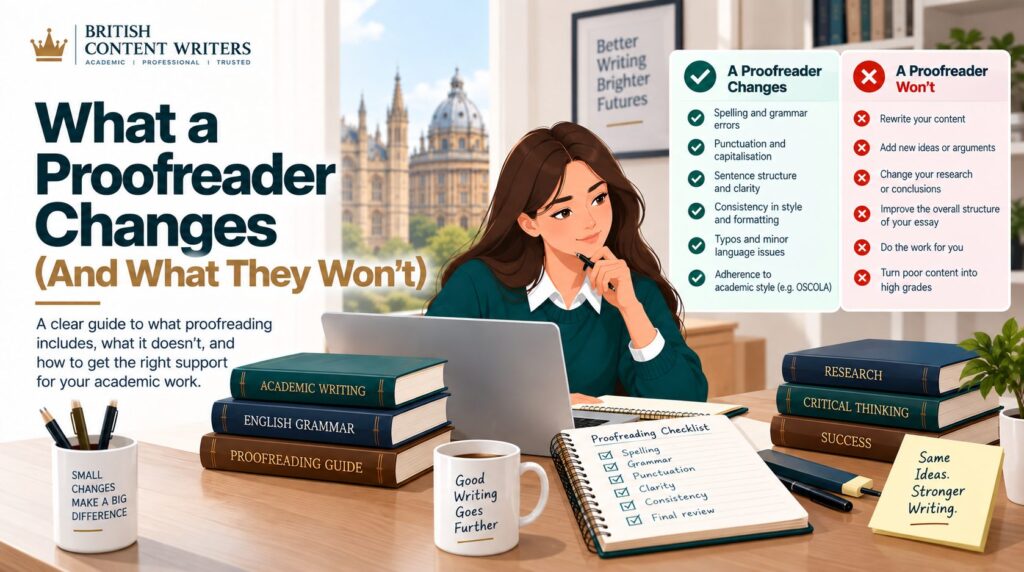






You have sent a piece of work off to be proofread, or you are about to, and the honest question underneath the polite one is simple: what actually happens to it? An academic proofreading service does not rewrite your argument, add new sources, or quietly improve your grade by making your points for you. It corrects how your work reads, not what it says, and the line between those two things is stricter than most people expect.
This post shows you exactly where that line sits. You will see a real marked-up example of a paragraph before and after a proofread, the full list of what is genuinely in scope, the list of what a proofreader will never touch, and why those limits exist in the first place. By the end, you will know precisely what to send, what to expect back, and how to tell a properly scoped proofread from one that has quietly gone further than it should.
None of this is a matter of opinion or house style dreamed up by a single business. The boundary described here tracks the same distinction UK universities themselves draw when they set out what students are and are not permitted to have done to their work before submission, which is why getting it right matters well beyond the quality of the final document.
What an Academic Proofreading Service Actually Changes: A Marked-Up Example
Descriptions of what proofreading covers are useful, but a worked example makes the boundary concrete in a way a bullet list cannot. Here is a short paragraph, the kind you might find in an undergraduate essay, before and after a genuine proofread, with every change named.
Before:
Recent studies has shown that remote working can effect employee productivity in different ways, some workers report they are more focused at home while others find it hard to concentrate, this creates a challenge for managers who’s trying to set consistent policy across a whole team. The data on this topic is inconclusive and more research is needed, especially research that looks at long term effects rather than the first few months after a policy changes. Companies like the one described by (Smith 2021) have tried hybrid models with mixed results.
After:
Recent studies have shown that remote working can affect employee productivity in different ways. Some workers report they are more focused at home, while others find it hard to concentrate. This creates a challenge for managers who are trying to set consistent policy across a whole team. Companies such as the one described by Smith (2021) have tried hybrid models with mixed results.
Line up the two versions and six specific changes stand out. ‘Studies has shown’ became ‘studies have shown’, a subject-verb agreement fix. ‘Effect’ became ‘affect’, a correct-word substitution that sits squarely within grammar.
The long, comma-spliced first sentence was split into three shorter sentences, each ending with proper punctuation rather than running on. ‘Who’s trying’ became ‘who are trying’, fixing an apostrophe error that had turned a contraction into the wrong word entirely. The citation format changed from ‘(Smith 2021)’ to ‘Smith (2021)’ to match a consistent in-text referencing style, which is a formatting check, not a content check, and ‘like’ was tightened to ‘such as’ for register consistency, appropriate for academic tone.
Notice what did not change. The sentence ‘the data on this topic is inconclusive and more research is needed’ was left untouched, even though a proofreader might privately think the paragraph would benefit from a specific citation to back that claim up. That is a content gap, not an expression problem, and flagging it with a comment for the student to address themselves is the correct response.
A proofreader who instead added a source here, however plausible, would have quietly strengthened the student’s argument with research the student never actually read or chose. Silently adding a source or rewriting the sentence to sound more authoritative would cross straight into the out-of-scope territory covered next. That flag-don’t-fix boundary is the one competing services rarely show you in practice, which is exactly why it is worth seeing in a real example rather than taking on trust.
The In-Scope List: What Every Legitimate Proofread Covers
A proofread genuinely covers six categories of correction, and understanding each one helps you see why the boundary sits where it does.
Grammar covers tense consistency, subject-verb agreement, and sentence construction, exactly the kind of fix shown in the example above. Punctuation covers comma splices, missing or misplaced punctuation, and consistent use of quotation marks and dashes throughout a document. Spelling and typographical errors includes making sure UK spelling is used consistently rather than slipping between UK and US conventions mid-document.
Consistency covers formatting, heading styles, numbering, and capitalisation, checked so they match across the whole document rather than varying from one section to the next. Referencing format means checking that citations and the reference list are formatted correctly and consistently in the required style, such as our Harvard referencing guide sets out, without adding, removing, or verifying the sources themselves. Clarity flags mean identifying, not rewriting, a sentence or passage where the meaning is genuinely hard to follow, so you can revise it in your own words rather than someone else’s.
The University of Nottingham’s own proofreading policy sets out a very similar permitted list, which is worth knowing since it means a properly scoped proofread should already sit comfortably inside what your own institution allows. Every item on this list corrects how the work is expressed. None of it touches what the work is actually saying.
Two of these categories are worth a closer look because they are the ones students most often ask about. Clarity flags in particular can feel like a grey area, since marking a sentence as unclear without saying how to fix it can seem unhelpfully vague at first. In practice, a good flag names the specific problem, such as pointing out that a sentence has two possible readings, without supplying the replacement wording, which keeps the final phrasing genuinely yours.
The Out-of-Scope List, Stated Plainly
The out-of-scope list matters more than the in-scope one, because vagueness here is exactly what erodes trust in a proofreading service. Here it is, without hedging.
A legitimate proofread will not restructure your paragraphs or sections. It will not rewrite sentences to strengthen or clarify your argument on your behalf. It will not add new content, sources, data, or citations that were not already in your draft.
It will not correct factual errors or check your calculations. It will not translate your work between languages. And it will not reorder your evidence or reasoning to make your conclusion land more convincingly, even where a proofreader can see exactly how that reordering would help.
Each of these crosses the same line for the same reason. The moment a proofreader restructures an argument, adds a source, or fixes a calculation, they have stopped correcting your expression and started contributing content, and content contribution is what universities across the UK treat as academic misconduct, regardless of how well-meaning the intent behind it was. A service that quietly does more than proofreading, even with good intentions, is putting your own academic standing at risk in the process, and that risk sits with you, not with the service.
Why These Limits Exist, and How They Protect You
It is easy to read the out-of-scope list as a restriction, a set of things a proofreader is being unhelpfully stopped from doing. Reframed correctly, every one of those limits exists to keep the final piece of work defensibly yours, and that is what actually protects your degree rather than getting in the way of it.
Think through what happens without that limit in place. A proofreader who rewrites a weak argument has, in that moment, made the argument partly their own, whether either party intended that or not. If you were then asked to defend that reasoning at a viva, in a supervision meeting, or simply in a follow-up question from a marker, you would be defending logic that was not fully yours to begin with, and that is a genuinely difficult position to be caught in.
These limits are not a business’s own invented rule designed to look cautious. They mirror UK university policy closely, including the University of Essex’s proofreading policy, which states plainly that proofreading should not entail any intervention that would substantially change the content of a piece of work. A proofreading service that respects this boundary is protecting the same thing your university’s own policy is designed to protect, which is the simple fact that the work submitted under your name is genuinely yours.
This is also why a properly scoped proofread and a properly scoped supervisor meeting end up looking quite similar in what they will and will not do for you. A supervisor can point out that a section is thin without writing the missing paragraph themselves, and a proofreader operates under the same principle, correcting how something is expressed while leaving the thinking behind it entirely in your hands.
What to Send and What You Get Back
Getting the most out of a proofread starts before the document is even sent. Three things are worth including alongside your draft: the specific citation style your institution requires, any house style or formatting guide it provides, and a note of any sections you already know are weak, so a proofreader can flag them precisely rather than leaving a general comment that is harder to act on.
What comes back should never be a silently altered final version with no record of what changed. A properly proofread document is returned either as tracked changes you can accept or reject individually, or as a clearly marked-up copy alongside your original, the same format used in the worked example earlier in this post. The Chartered Institute of Editing and Proofreading sets out this kind of visible, accountable practice as a basic professional standard, not an optional extra.
Visible tracked changes matter for a reason that goes beyond convenience. It is the same transparency principle that several UK university proofreading policies require directly, and practically speaking, it gives you the final say over every single change before any of it becomes part of your submitted work. If a service cannot show you exactly what it changed, there is no way to confirm it stayed inside the boundary this post has just described.
It is also worth agreeing turnaround expectations before you send anything, since a rushed proofread under time pressure is more likely to miss the kind of consistency issue that only becomes visible when someone reads the whole document in one sitting. A few days’ buffer before your own submission deadline gives you time to review the tracked changes properly, rather than accepting them all at once simply to meet the clock.
Getting Your Work Proofread Properly
A proofread should change how a piece of work reads without changing what it says. That is the entire principle this post has walked through, from the marked-up example at the top to the in-scope and out-of-scope lists to the reasoning behind them, and a marked-up, tracked-changes return is the clearest evidence you can ask for that this is exactly what happened to your own work.
If you are about to send a dissertation, essay, or thesis for proofreading, the questions to ask are now straightforward. Does the service state its scope clearly? Will it return tracked or visibly marked changes rather than a silent rewrite?
Does that scope match the in-scope list this post has set out, nothing more and nothing less? A service that answers yes to all three is one you can trust with work that has to remain genuinely your own, and one you can defend without hesitation if anyone ever asks what changed and why.