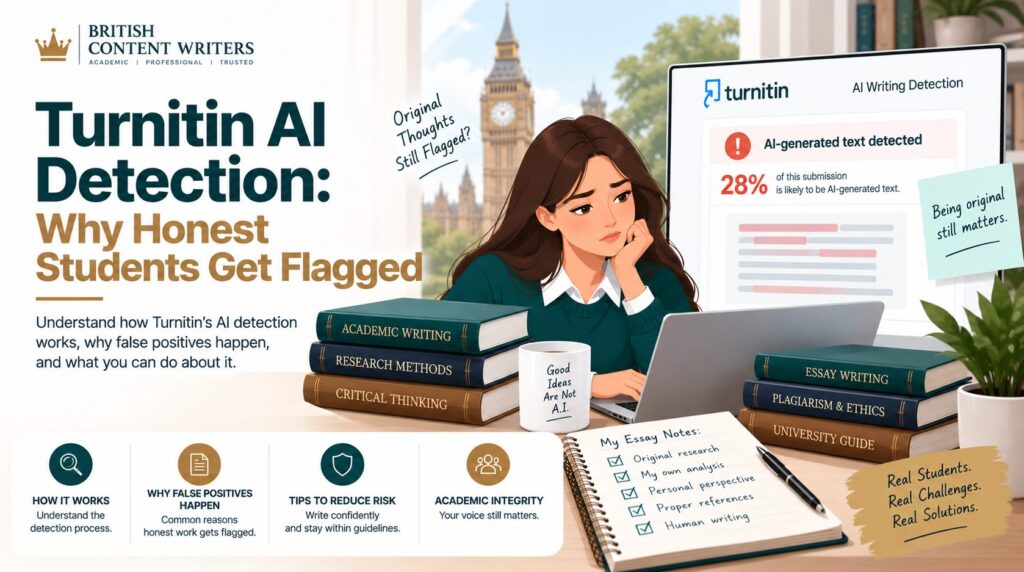






You’re looking at a Turnitin AI score on an essay you wrote yourself, and the number is making you question a piece of work you know you didn’t cheat on. That reaction is completely understandable, and it’s worth saying plainly before anything else: a score on its own doesn’t mean you did anything wrong.
This guide covers Turnitin AI detection calmly and factually: how the tool actually works and why it produces a probability rather than a verdict, the documented patterns behind genuine false positives, what a score is and isn’t evidence of, what to do if your own honest work gets flagged, and how to use AI tools within your university’s policy without raising unnecessary suspicion.
Turnitin AI Detection: How It Works and Why It’s Probabilistic, Not Definitive
The tool works by measuring patterns in a piece of writing that are statistically associated with large language model output, not by checking the text against a database of every AI-generated document that exists. No such database could exist, since a language model can produce an effectively unlimited number of different outputs for the same prompt.
In practical terms, this means the model is looking at things like sentence-length variation, word choice predictability, and how uniform the writing’s rhythm is across a document. Human writing tends to vary more from sentence to sentence, in length, structure and word choice, than most AI-generated text does by default, and that variation, or the lack of it, is a large part of what the underlying statistical model is actually picking up on.
This is also why the same underlying signal can appear in genuinely human writing that happens to be unusually uniform, a tightly structured methods section written to a strict template, for example, or a student who was specifically taught to write in short, consistent sentences for clarity. The model measures a pattern, not a cause, and more than one genuine cause can produce a similar pattern.
Turnitin’s own documentation describes three distinct things the model looks for: text likely generated directly by a large language model, text likely revised using an AI-paraphrasing tool, and likely use of an AI ‘bypasser’ tool that tries to disguise AI-generated text as human-written. These are treated as separate categories, not a single undifferentiated flag.
Turnitin has published its own false positive rate figures directly, and they’re worth stating plainly rather than estimating. At document level, for documents already showing 20% or more flagged content, the published false positive rate is under 1%. At the individual sentence level, the published rate is around 4%, meaning roughly one in twenty-five individually highlighted sentences might be human-written despite being flagged.
There’s a specific safeguard built into the tool as a direct response to this risk. Scores between 1% and 19% are marked with an asterisk and left unattributed to a specific cause, precisely because that low range is where a false positive is statistically more likely to occur.
A probabilistic measurement of statistical likelihood is fundamentally different from a factual determination of what actually happened. That distinction is exactly why Turnitin’s own guidance states that an AI writing score should never be the sole basis for an academic misconduct decision, a standard worth remembering if a score of yours is ever raised as a concern.
Documented False-Positive Patterns: Who Gets Flagged and Why
The research behind this topic is more nuanced than a single headline finding, and the nuance itself is genuinely reassuring once it’s laid out in full.
The concern was first raised widely by a 2023 Stanford study that tested a small set of TOEFL essays, each under 150 words, against several AI detectors available at the time. It found these detectors consistently misclassified non-native English writing as AI-generated far more often than native English writing, and linked this to the more constrained, formulaic phrasing patterns common in second-language academic writing.
Turnitin later published its own, considerably larger research directly responding to that concern. Testing roughly 2,000 texts per category across native and non-native English writers, the study found no statistically significant bias against non-native writers once a document met Turnitin’s recommended minimum length. It did find meaningfully higher false-positive rates for submissions shorter than that minimum, and a genuine gap between native and non-native writers specifically within that shorter range.
The practical takeaway is more precise, and less alarming, than the original headline finding alone suggests. Length and formulaic phrasing are the documented risk factors, not simply being a non-native English speaker submitting a properly developed piece of work.
There’s a third documented pattern worth knowing about directly. Heavy use of paraphrasing tools or advanced grammar-rewriting features, the kind built into some writing assistants, can specifically trigger the ‘likely revised using an AI-paraphrasing tool’ category, even when the underlying ideas, structure and argument are entirely the student’s own.
The original Stanford study on GPT detector bias and Turnitin’s own research addressing it directly are both worth reading in full if this is a topic you want the complete picture on, rather than relying on either side’s summary alone.
This isn’t a purely academic debate either. HEPI’s 2026 report on AI detection and UK international students documents real cases handled by the Office of the Independent Adjudicator, the body that reviews complaints against UK universities, where students disputed an AI misconduct finding and had it upheld or partly upheld in their favour. One case in that report involved a student penalised after using an online tool to look up English synonyms, a genuinely ordinary study habit rather than anything resembling academic dishonesty. Cases like this are exactly why UK universities are increasingly building a human review stage into any process that starts with a flagged score, rather than treating the score as a finding on its own.
What a Turnitin AI Score Is and Isn’t Evidence Of
A Turnitin AI score is a statistical estimate of how much of a document’s language resembles patterns associated with AI-generated text, produced by a specific model with a published, non-zero error rate. That’s genuinely all it is.
It isn’t proof that a student used AI, it isn’t a plagiarism finding, and it isn’t a determination of intent. The tool has no way to distinguish a student who writes in a formulaic academic style from an AI-generated passage, only that the two can look statistically similar to the model measuring them.
This distinction has a real practical consequence. Most UK universities’ own procedures require a flagged score to be treated as a prompt for a conversation or a formal process with an opportunity to respond, rather than as a finding in itself, precisely because of this limitation in what the tool can actually establish.
A score also shouldn’t be read in isolation. The full context, the writing and drafting process behind it, the assignment’s own requirements, and the student’s own account, will always tell a fuller story than an isolated number on its own.
A concrete example makes this clearer. Two students submit essays with an identical 15% AI writing score. One genuinely used an AI tool to write several paragraphs and lightly edited them afterwards, while the other wrote every word themselves, in a clear, structured academic style with consistent sentence lengths, the kind of writing years of essay practice tends to produce.
The score alone cannot tell these two situations apart. That’s precisely why it functions as a starting point for a conversation rather than as the conversation’s conclusion, and why the evidence covered in the next section matters so much more than the number itself.
What to Do If You’re Wrongly Flagged: Evidence to Keep and How to Present It
The first practical step is a calm one: don’t panic, and don’t try to explain the score away with words alone. A measured, evidence-based response is considerably more persuasive to an academic panel than a purely verbal denial, however genuine that denial is.
It’s worth having certain evidence ready before any conversation happens, and it helps to think of it as a short checklist rather than a single item to produce:
- Version history in Google Docs, Word, or whatever platform the piece was written in, showing incremental edits made over time rather than a single block of text appearing all at once.
- Earlier drafts and outlines, even rough ones, saved separately from the final submission.
- Research notes, saved articles, or a reading list showing engagement with sources before the writing stage.
- Any record of AI tool use that stayed within permitted bounds, a chat log showing a tool was used only to check grammar or brainstorm ideas, for instance, rather than to generate finished text.
Version history is usually the single strongest item on that list, since it’s genuinely difficult to fake convincingly. A document that shows hours of incremental editing across several sessions tells a very different story from one that appeared, fully formed, in a single save.
The drafting-history angle deserves its own mention specifically. A genuine essay usually shows visible development across its version history, an argument that changed, errors that were corrected, a structure that evolved as the writing progressed. A single AI-generated paste typically doesn’t show that kind of development, which makes a clear version history one of the more persuasive things a student can point to.
A consistently developed, correctly formatted reference list across drafts is a small but genuine piece of supporting evidence too, since it shows engagement with sources built up over time rather than a default or fabricated list. Our Harvard referencing guide is worth checking your own reference list against if that’s the citation style your course requires, since consistency there is part of the same picture.
It’s worth understanding that most universities run this as a staged process rather than a single decision point. An initial flag typically leads to an informal conversation with a tutor or module leader first, giving a student the chance to explain and provide evidence before anything becomes a formal academic conduct case. Only a smaller proportion of flagged scores progress beyond that informal stage, precisely because the conversation itself usually resolves genuine misunderstandings.
Finally, ask specifically what process your university follows for a flagged score, since this varies by institution and is usually published in a student handbook or academic conduct policy. Knowing the actual process in advance is considerably less stressful than discovering it while already going through it.
Using AI Legitimately Within Your University’s Policy
Most UK universities now permit some level of AI use, for research, checking grammar, brainstorming, or clarifying a concept, provided it’s disclosed where required and never submitted as unacknowledged original work in a piece of summative assessment.
A useful rule of thumb: if AI-generated content would need to be quoted or cited as someone else’s words had a human produced it, treat it the same way when a tool produced it instead.
Permitted use varies by module, and sometimes by specific piece of coursework within the same course, so it’s worth checking the policy for each individual assignment rather than assuming a single course-wide rule applies to everything.
Where disclosure is required, it doesn’t need to be complicated. A short statement such as ‘I used an AI tool to check grammar and suggest alternative phrasing on an early draft, all analysis and argument are my own’ gives an assessor exactly what they need to evaluate the work fairly, and it takes less time to write than most students expect.
Transparent, disclosed AI use, kept alongside a visible drafting history, is the single strongest protection available against an honest flag turning into a stressful process. Neither element alone is as effective as having both in place together.
Before You Worry
A Turnitin AI score is a statistical flag, not a verdict. The strongest position an honest student can be in is a visible drafting history, transparent and policy-compliant AI use where any was involved, and supporting materials, including a consistently referenced source list, kept organised as the work develops rather than assembled after the fact.
None of this requires treating every assignment as though it might be questioned. It just means the habits that make for good academic work in the first place, drafting properly, citing consistently, and using AI tools openly where they’re allowed, are the same habits that hold up well if a score is ever raised as a concern.
A single number on a report is rarely the full picture, and every process described above exists specifically because universities already understand that. Treat a flag as a reason to gather your evidence calmly, not as a reason to assume the worst before anyone has actually looked at it.
If you take one thing from this guide, make it the version-history habit rather than any single statistic. Saving drafts as you go, rather than writing in one sitting and submitting a single final file, protects you regardless of whether a score ever gets raised at all, and it’s a far easier habit to build before an assignment is due than to wish you had afterwards.