







Writing a research paper in the UK isn’t just about gathering sources and putting words on a page. It’s about critical thinking, structured argument, and demonstrating that you understand how academic conversations work.
Many students, especially international students, assume that writing a research paper is similar everywhere. It isn’t. UK universities place strong emphasis on independent analysis, balanced evaluation, and precise referencing. Simply describing information will not earn high marks. You’re expected to question, compare, critique, and contribute to scholarly discussion.
If you’ve ever felt unsure about where to start, how to structure your paper, or which citation style to use, you’re not alone. This guide breaks everything down clearly from choosing a topic to building a solid structure that meets UK academic standards.
Whether you’re an undergraduate tackling your first assignment or a postgraduate refining your research skills, this article will walk you through exactly how writing a research paper in the UK should be approached in 2026 and beyond.
What Is a Research Paper in the UK Academic Context?
A research paper is a structured academic document that presents an original argument supported by credible sources, data, and critical analysis.
In UK universities, a research paper is not:
- A simple summary of existing studies
- A personal opinion piece
- A loosely structured essay
Instead, it is a carefully organised investigation built around a clear research question.
Research Paper vs Essay
An essay typically argues a point based on existing literature. A research paper goes further. It may involve:
- Original data collection
- Methodological explanation
- Identifying research gaps
- Analytical frameworks
Research Paper vs Dissertation
A dissertation is longer, more comprehensive, and often required at postgraduate level. A research paper is shorter but still demands academic rigour.
If you’re unsure about expectations, reviewing university marking rubrics is essential. Many institutions clearly outline criteria such as:
- Depth of research
- Critical analysis
- Structure and coherence
- Proper referencing
- Original insight
Understanding these benchmarks early can save you significant revision time later.
Choosing the Right Research Topic
One of the biggest mistakes students make is choosing a topic that’s either too broad or too narrow.
A strong topic should be:
- Relevant to your module
- Researchable using credible sources
- Clear and focused
- Aligned with assignment guidelines
For example:
❌ “The impact of social media” (too broad)
✅ “The impact of Instagram marketing on purchasing behaviour among UK Gen Z consumers” (focused and measurable)
Use the SMART Approach
- Specific: Clearly defined research focus
- Measurable: Can be supported by data
- Achievable: Within word count limits
- Relevant: Linked to course objectives
- Time-bound: Researchable within deadline
Before committing, check source availability through academic databases such as:
- Google Scholar
- JSTOR
- University library portals
If you feel stuck refining your topic, reviewing examples from a professional research paper writing service can provide clarity on structure and focus. You can explore guidance.
Conducting Academic Research Properly
Strong research separates high-distinction papers from average submissions.
Use Credible Academic Sources
Prioritise:
- Peer-reviewed journal articles
- Academic books
- Government reports
- Official statistical databases
Avoid:
- Blogs
- Wikipedia
- Unverified websites
Primary vs Secondary Research
- Primary research: Interviews, surveys, experiments
- Secondary research: Analysing existing literature
Both are valid, but you must explain your methodology clearly.
Organising Your Research
Using reference management tools such as:
- Zotero
- Mendeley
- EndNote
can save hours during citation formatting.
For detailed citation formatting, consult the Harvard referencing guidelines available through the Purdue OWL. Their breakdown of in-text citations and reference lists is widely trusted in both UK and USA academic environments.
Taking organised notes is equally important. Instead of copying paragraphs, summarise key arguments in your own words and note page numbers for later referencing. This prevents accidental plagiarism.
Standard Structure of a Research Paper in the UK
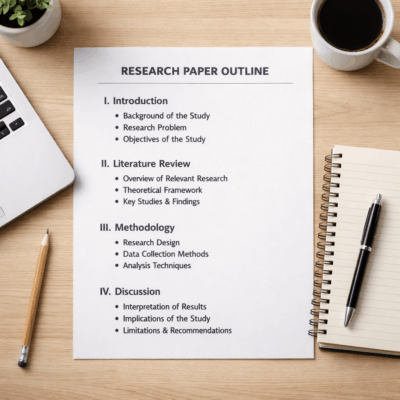
Structure matters more than students realise. Even excellent research can lose marks if it’s poorly organised.
Below is the standard format expected in most UK universities.
1. Title Page
Typically includes:
- University name
- Module code
- Student ID (not always your full name)
- Word count
- Submission date
Always check specific institutional guidelines.
2. Abstract
The abstract is a concise summary of your research paper, usually 150-250 words.
It should include:
- Research purpose
- Methodology
- Key findings
- Main conclusion
Write the abstract last, even though it appears first.
3. Introduction
Your introduction should:
- Provide background context
- Introduce your research question
- Present your thesis statement
- Outline the structure of the paper
A common mistake is being too vague. Be precise about what the paper aims to demonstrate.
4. Literature Review
This section evaluates existing research relevant to your topic.
Instead of listing studies, you should:
- Compare viewpoints
- Identify contradictions
- Highlight research gaps
- Build a foundation for your own argument
In UK academic writing, synthesis is critical. You are expected to show how different sources connect to one another.
5. Methodology
Explain:
- Research design
- Data collection methods
- Sampling techniques
- Ethical considerations
If your study involves participants, you must mention ethical compliance, particularly in relation to UK data protection standards.
6. Results / Findings
Present data clearly and objectively.
Use:
- Tables
- Charts
- Statistical summaries
Avoid interpretation here that belongs in the discussion section.
7. Discussion
This is where you interpret your findings.
- Do your results support previous research?
- Do they challenge existing theories?
- What are the implications?
Strong critical evaluation is essential.
8. Conclusion
Your conclusion should:
- Restate the research question
- Summarise key findings
- Discuss limitations
- Suggest future research directions
Avoid introducing new arguments here.
9. References
All sources must be listed alphabetically and formatted consistently.
UK universities commonly use:
- Harvard
- APA
- OSCOLA (for law students)
For law assignments, detailed guidance on the OSCOLA referencing system is available through University of Oxford resources.
Why Structure Impacts Your Grade
Markers often assess structure before content depth. A well-organised paper signals clarity of thought.
Poor structure can lead to:
- Lower coherence
- Weakened argument flow
- Reduced critical impact
If you’re unsure about formatting expectations or need a structured template tailored to your discipline, reviewing academic examples or consulting professional guidance can help you avoid costly mistakes.
Citation Styles Used in UK Universities
Referencing isn’t just a technical requirement. In UK academia, it demonstrates credibility, research depth, and intellectual honesty.
The most commonly used citation styles include:

Harvard Referencing (Most Common)
Harvard is widely used across UK universities, especially in business, social sciences, and humanities.
In-text citation example:
(Smith, 2022)
Reference list example:
Smith, J. (2022) Title of Book. London: Publisher.
Consistency is key. Even small formatting inconsistencies can affect marks.
For detailed formatting help, consult the Harvard referencing guidelines from Purdue OWL, which provides clear examples for citations and reference lists.
APA Referencing
APA is commonly used in psychology, education, and some sciences. It is similar to Harvard but includes specific formatting rules for headings and DOI references.
OSCOLA Referencing (For Law Students)
If you’re studying law, you’ll likely use OSCOLA. Unlike Harvard or APA, OSCOLA uses footnotes instead of in-text citations.
For official formatting standards, refer to the OSCOLA referencing system provided by University of Oxford.
Chicago Style
Less common but occasionally required in history or arts disciplines.
Common Citation Mistakes to Avoid
- Mixing citation styles
- Forgetting page numbers for direct quotes
- Incorrect punctuation in references
- Missing sources in the reference list
- Overusing direct quotations
Remember: referencing errors are avoidable marks lost.
Academic Writing Style & Tone in the UK
Academic writing in the UK prioritises clarity, objectivity, and analytical depth.
Here’s what markers expect:
1. Formal Tone
Avoid contractions:
❌ “don’t”
✅ “do not”
Avoid casual phrasing:
❌ “a lot of”
✅ “a significant amount of”
2. Third-Person Perspective
Most UK research papers are written in third person unless specifically instructed otherwise.
Instead of:
I believe the results show…
Write:
The findings suggest…
3. Critical Analysis Over Description
Many students lose marks because they describe rather than analyse.
Descriptive writing explains what happened.
Critical writing evaluates why it matters.
For example:
Descriptive:
Smith (2020) found that social media affects students.
Critical:
Smith’s (2020) findings highlight a correlation between social media use and academic distraction; however, the study lacks longitudinal data, limiting its broader applicability.
See the difference? That’s the level of thinking UK universities expect.
4. Avoiding Plagiarism
Plagiarism can lead to severe academic consequences.
Most UK institutions use Turnitin to detect similarity. A similarity score isn’t automatically bad context matters, but excessive copying signals poor paraphrasing.
If you are unsure how to refine your writing or improve originality, reviewing structured academic samples or seeking expert feedback can help. You can explore structured assistance.
Common Mistakes Students Make
Even capable students make avoidable errors. Here are the most frequent issues:
1. Weak Thesis Statement
Your thesis must clearly answer your research question. If it’s vague, your argument becomes unclear.
2. Poor Time Management
Rushing research often leads to weak sources and structural mistakes.
3. Lack of Coherence Between Sections
Your introduction, discussion, and conclusion should align. If your findings do not address your research question directly, your paper loses focus.
4. Over-Reliance on Outdated Sources
In many subjects, sources older than 10 years may weaken credibility unless they are foundational theories.
5. Ignoring Feedback
If this isn’t your first research paper, revisit previous tutor comments. Patterns often repeat.
Editing, Proofreading & Final Checks
Submitting without proper editing is one of the biggest academic risks.

Step 1: Structural Review
- Does the introduction clearly state your argument?
- Do paragraphs flow logically?
- Does each section serve a purpose?
Step 2: Citation Audit
Cross-check every in-text citation with the reference list. Even one missing source can affect marks.
Step 3: Grammar & Clarity
Read your paper aloud. Awkward sentences become obvious when spoken.
Step 4: Word Count Compliance
UK universities are strict about word count limits. Exceeding limits can result in penalties.
Step 5: Final Professional Review (Optional but Valuable)
If your paper carries high stakes, final year, postgraduate level, or scholarship submission, having a second set of academic eyes can make a difference.
You can check detailed pricing options Or submit your assignment directly.
For tailored academic guidance, reach out.
When Should You Seek Professional Support?

There’s a difference between ethical academic support and academic misconduct.
Professional guidance is helpful when:
- You’re unclear about structure
- English isn’t your first language
- You’re working under tight deadlines
- You need help refining methodology
- You want proofreading before submission
Seeking expert input doesn’t replace your learning, it enhances it when used responsibly.
Final Thoughts
Writing a research paper in the UK is not about filling pages. It’s about demonstrating intellectual independence, structured reasoning, and analytical depth.
If you approach your assignment with:
- A clear research question
- Strong academic sources
- Proper structure
- Accurate citations
- Critical evaluation
you position yourself for higher marks.
And if you ever feel unsure, remember: clarity, structure, and critical thinking always outweigh word count alone.