
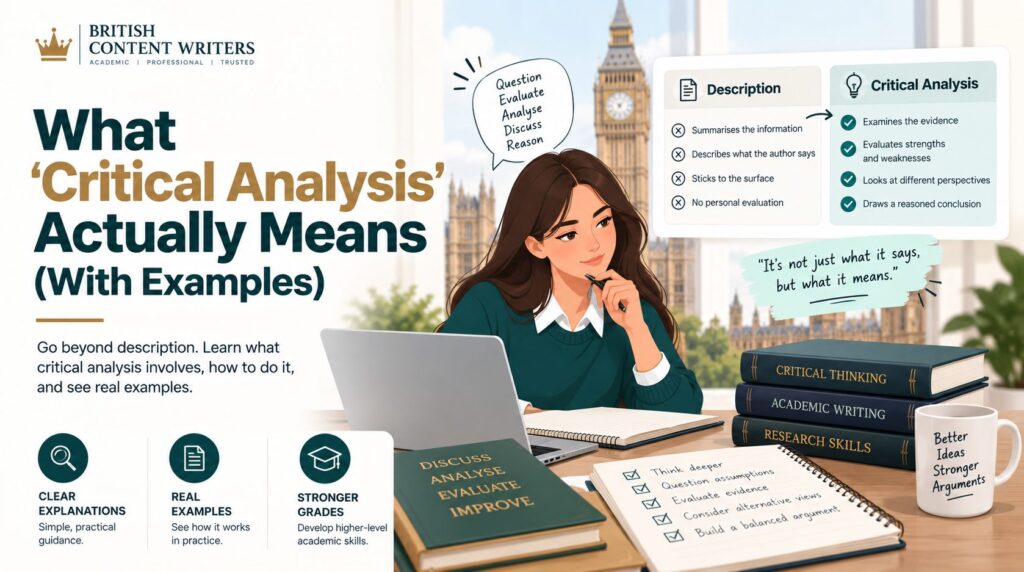






Your feedback sheet says ‘too descriptive’ or ‘needs more critical analysis’, sitting next to a paragraph you were fairly confident about when you handed it in. It’s the single most common comment on UK feedback sheets, and it rarely comes with much explanation of what would actually have made the paragraph different.
What critical analysis academic writing actually rewards isn’t a different vocabulary, it’s a different kind of sentence, one that makes a judgement rather than reports a fact. This guide shows exactly what that shift looks like: five real paragraphs rewritten from descriptive to critical and annotated line by line, the sentence stems that force analysis structurally, and a three-question self-test to run against your own writing before you submit.
Critical Analysis Academic Writing: Why ‘Too Descriptive’ Is the Most Common Feedback Comment
Critical analysis means weighing evidence, arguments or ideas against each other and reaching a defensible judgement about them, rather than simply reporting what a source says. It’s an evaluative skill, not a descriptive one, and that distinction is where most of the confusion starts.
The single biggest misconception is that ‘critical’ means negative, finding fault, or picking holes in an argument you happen to disagree with. It doesn’t. A critical analysis of a study you broadly agree with still has to weigh its strengths against its limitations and state where its evidence is strong and where it’s thinner, agreement doesn’t exempt a source from being evaluated.
Description feels safer to write than analysis, and that’s worth naming honestly rather than treating purely as a skills gap. A fact can be checked and is either right or wrong, whereas a judgement can be challenged, disagreed with, or marked down if it’s poorly supported. Writing that plays it safe by staying descriptive is often a reasonable, if costly, response to that pressure, rather than a failure to understand the material.
Markers generally aren’t grading whether you’ve correctly reported what a source says, most rubrics assume accurate reporting as a baseline and reward what you do with it beyond that. University of Reading’s guide to writing critically approaches this same distinction from a different angle, worth reading alongside this section if the difference still feels abstract rather than practical.
The useful news is that the shift from descriptive to critical writing is mechanical enough to learn directly, rather than something that requires becoming a more insightful person before you can write insightfully. The paragraphs below show exactly what changes, sentence by sentence, when a descriptive paragraph is rewritten as a critical one.
Subjects vary in how explicitly they name this expectation. A rubric might use ‘analyse’, ‘evaluate’ or ‘critically evaluate’ rather than the phrase ‘critical analysis’ directly, but the underlying demand is the same one covered here: judge the evidence rather than only summarise it. If your own assignment brief uses different command words, treat them as pointing at the same skill rather than a separate one you need to learn from scratch.
Five Before-and-After Paragraph Pairs, Annotated
Here are five paragraphs on different subjects, each shown first in its descriptive form, then rewritten critically, with the specific change named afterwards. The subjects vary deliberately, so the pattern reads as general technique rather than something tied to one field.
1. History and politics
Descriptive: The Representation of the People Act 1918 extended the vote to women over 30 who met a property qualification, and to all men over 21. This widened the electorate considerably compared with the previous system. The Act was passed by Parliament in February 1918.
Critical: The Representation of the People Act 1918 extended the vote to women over 30 who met a property qualification, yet the age and property conditions meant working-class women under 30 remained excluded, so the reform addressed the principle of enfranchisement without fully addressing the class basis of the previous system. This partial extension suggests the Act was shaped as much by what Parliament judged politically safe to concede as by a genuine commitment to equal representation. That distinction matters because it explains why full equal suffrage took a further ten years to arrive rather than following immediately.
What changed: The critical version adds a ‘yet’ clause naming a specific limitation the descriptive version omits, then draws an interpretive judgement about what the limitation reveals, and finally connects that judgement forward to a consequence. Nothing factual was added, the same event is simply weighed rather than only reported.
2. Psychology and social science
Descriptive: Several studies have found that students who sleep for longer before an exam tend to perform better than those who sleep less. Researchers have suggested this is linked to memory consolidation during sleep. This pattern has been observed across a range of subject areas.
Critical: Several studies have found that students who sleep for longer before an exam tend to perform better, though the studies most often cited rely on self-reported sleep duration rather than measured sleep, which weakens confidence in the size of the effect. Memory consolidation during sleep offers a plausible mechanism, but it does not rule out a simpler explanation, that well-prepared students may also be more likely to prioritise sleep in the first place. Distinguishing between these explanations matters because it changes whether practical advice should focus on sleep itself or on the underlying study habits sleep may simply reflect.
What changed: The critical version names a methodological limitation (self-reported rather than measured data), introduces a competing explanation for the same pattern, and closes on why choosing between the two explanations actually matters. The descriptive version states the finding as settled, the critical version treats it as a claim still worth interrogating.
3. Business and management
Descriptive: Many organisations introduced remote working policies during 2020 and continued to offer them afterwards. Employees frequently reported valuing the flexibility this gave them. Some organisations have since asked staff to return to the office for a set number of days each week.
Critical: Many organisations introduced remote working policies during 2020 and continued to offer them afterwards, but the subsequent shift towards mandated office days suggests that employee-reported flexibility and organisational priorities around collaboration and oversight were not as aligned as the initial policies implied. Framing this simply as employees valuing flexibility overlooks the tension between individual preference and the coordination costs remote work can create for a team, a tension that only became visible once organisations had time to measure it rather than assume it. The return-to-office trend is therefore better read as organisations recalibrating that balance than as a straightforward reversal of a failed policy.
What changed: The critical version reframes a single reported fact (employees valued flexibility) as one side of an unresolved tension, then offers a specific interpretive label, recalibration rather than reversal, for the trend described. The judgement is contestable, which is exactly what makes it analysis rather than description.
4. Health and public policy
Descriptive: Public health campaigns encouraging handwashing were widely run during the COVID-19 pandemic. These campaigns used posters, adverts and signage in public places. Handwashing has long been recommended as a way to reduce the spread of infection.
Critical: Public health campaigns encouraging handwashing were widely run during the pandemic, but their reliance on posters and signage assumes that low awareness, rather than inconsistent access to handwashing facilities or time pressure during a working day, was the main barrier to the behaviour. Handwashing has long been recommended as a way to reduce infection, so it is worth asking why repeated awareness campaigns were judged necessary if the underlying knowledge was already widespread. This suggests the campaigns may have been targeting the wrong barrier, treating an access or habit problem as an information problem.
What changed: The critical version challenges an unstated assumption behind the intervention (that awareness, not access, was the barrier), raises a genuine evaluative question, and reaches a specific judgement about intervention design. The descriptive version simply confirms that campaigns happened.
5. English literature
Descriptive: The narrator of the novel tells the story from a first-person perspective throughout. Some of the narrator’s claims are later contradicted by other characters. This creates uncertainty for the reader about what has actually happened.
Critical: The narrator’s first-person perspective initially reads as intimate and trustworthy, which makes the later contradictions from other characters more disorienting than if the unreliability had been signalled earlier. Rather than simply creating uncertainty, this delayed reveal forces the reader to re-evaluate everything the narrator has already said, shifting the novel’s central tension from what happened to why the narrator needed to tell it that way. Read this way, the unreliability functions as a comment on self-justification rather than as a plot device used purely to surprise the reader.
What changed: The critical version moves from stating that a technique exists (unreliable narration) to interpreting its effect on the reader and arguing for its thematic function within the novel. It makes a claim about what the technique means, not just that it’s present.
University of Leeds’ critical writing guide has three further worked examples in the same descriptive-versus-critical format, worth a look if you want more practice pairs beyond the five here.
Sentence Stems That Force Analysis Instead of Description
Sentence stems work because they force a because, a contrast, or a judgement into the sentence’s own grammar, which makes it structurally awkward to finish the sentence purely descriptively. Try opening a sentence with one of these the next time a paragraph is drifting descriptive.
‘This matters because…’ ‘A limitation of this is…’ ‘In contrast to X, Y suggests…’ ‘This raises the question of…’ ‘Taken together, these findings indicate…’ ‘One explanation for this is…, although an alternative is…’ ‘While X is broadly accepted, it is worth questioning…’
Each one forces you to complete a thought that a purely descriptive sentence doesn’t need: a reason, a contrast, an implication, or a competing possibility. You genuinely cannot finish ‘a limitation of this is’ with a plain restatement of what a source found, the sentence structure itself demands an evaluative claim.
One caution worth stating plainly: a paragraph built entirely from the same one or two stems, repeated every few sentences, reads as mechanical rather than genuinely analytical, and an experienced marker will notice the pattern quickly. Use these to get unstuck when a paragraph is drifting descriptive, not as a template to fill in for an entire essay.
It’s worth noticing that stems don’t do the analytical work themselves, they only force you towards the sentence structure that analysis needs. Writing ‘a limitation of this is that the sample size was small’ still requires you to have actually identified a real limitation, the stem just stops you from stopping at the sentence before it, the one that would have simply reported the sample size without judging it.
University of York’s guide to criticality in academic writing has a fuller glossary of critical versus descriptive instructional language, useful if your own rubric uses command words beyond the ones covered directly here.
How to Build a Paragraph That Argues Instead of Reports
A paragraph that argues rather than reports usually follows a simple structure: state the point you’re actually making, not just the topic, bring in the evidence, then explicitly connect that evidence back to your point with a because, therefore, or however clause, rather than leaving the connection implied.
The most common structural failure at this stage isn’t a lack of sources, it’s a paragraph that summarises two or three sources back to back with no sentence connecting them to each other or to the essay’s actual argument. Each source gets reported accurately and then sits there, unconnected to anything, waiting for the reader to do the analytical work the writer left out.
Adding more sources doesn’t fix this if each one is still only being reported. Three sources listed side by side is still description, just a longer version of it, whereas two sources explicitly weighed against each other, one supporting a claim and one complicating it, counts as analysis even in a shorter paragraph.
Referencing accurately matters throughout this process, since a judgement that misattributes or loosely paraphrases its evidence undermines the argument it’s meant to support. Our Harvard referencing guide is worth checking against if that’s the citation style your rubric requires, so the argument you’ve built doesn’t get undermined by an avoidable referencing error.
The test for whether a paragraph argues or reports is simple: read its last sentence on its own. If it restates a fact from earlier in the paragraph, it’s still reporting. If it makes a claim that couldn’t stand without the evidence that came before it, connecting cause, contrast or consequence explicitly, it’s arguing.
A Three-Question Self-Test for Every Paragraph You Write
Run these three questions against every paragraph before moving on to the next one, ideally while you’re still drafting rather than only at the final proofreading stage.
Does this paragraph make a judgement, or does it just report a fact? If you could delete the paragraph’s final sentence and lose nothing but a restated fact, there’s no judgement in it yet.
Could a reasonable reader disagree with what I’ve just written? If not, and the paragraph only states things that are straightforwardly true and checkable, it’s very likely still descriptive, since a genuine judgement is always at least a little contestable.
Have I connected this evidence back to my actual argument in an explicit sentence, using a because, therefore, or however, rather than leaving the connection for the reader to infer? An implied connection is invisible to a marker working through dozens of scripts, even when it feels obvious to the person who wrote it.
The fastest way to apply this test in practice is to compare a paragraph you’re unsure about against the annotated pairs above, rather than trying to judge it in isolation. Once you’ve seen the specific sentence-level changes that move a paragraph from one side of the line to the other, spotting the same pattern in your own writing gets noticeably quicker.
Before You Submit
The difference between descriptive and critical writing is rarely about vocabulary or sounding more intelligent, it comes down to whether a judgement and an explicit because or therefore connection actually appear on the page. Every example above makes the same underlying move: stating a stance a reader could disagree with, then connecting it back to the evidence with a specific reasoning word rather than a mere sequence of facts.
If you’ve applied the self-test above and you’re still not sure whether a particular paragraph has crossed the line, a second pair of eyes reading specifically for that distinction usually catches what’s hard to see in your own writing. That’s exactly the kind of targeted check worth arranging before a final submission, rather than after the feedback comes back, and it’s a far more useful use of that second read than a general proofread focused only on grammar and typos.